
The question sounds provocative, but it is being asked in earnest right now – in strategy meetings, in budget discussions, in expert circles. If AI writes reports, monitors regulation, scans supply chains and calculates climate scenarios: what is left for humans?
The answer is not: nothing. It is: something fundamentally more important than before. Because what AI makes possible is not the abolition of the ESG function – it is its liberation from the reporting straitjacket it has been stuck in for years.
AI does not replace ESG expertise. It finally gives it the room it always needed.
From Compliance Role to Strategic Function
The ESG manager's job profile has grown historically – and was shaped by regulatory requirements, not by a will to shape strategy. The result: sustainability teams that spend most of their capacity on data collection, manual reporting and compliance documentation.
AI breaks this pattern. Not as a miracle machine, but as a structural shift in what can be automated – and what is therefore left for humans. The direction of this shift is clear:
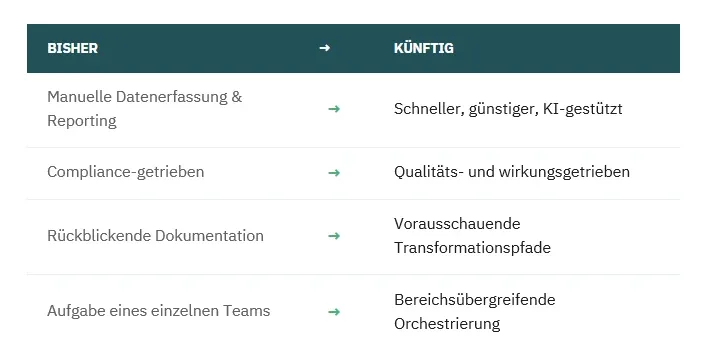
This is not a theoretical vision of the future. It describes a change that is happening right now – in companies that already use AI for ESG processes today.
The Value Pyramid: Where ESG Really Has an Impact
To understand where the role is heading, it helps to look at the three levels of sustainable corporate management. They differ not only in their complexity, but also in how much human judgement is required – and how little AI can deliver on its own here.
Innovation & Change
Strategic Value · Securing the Future
Anticipating new regulations and technologies, developing circular business models, shaping AI ecosystems. This is where it is decided who the market leaders of tomorrow will be.
Business Development & Growth
Competitive Advantage
Sustainable products and services, resource efficiency as a cost lever, brand trust and new value-creation partnerships. Sustainability becomes part of the competitive strategy.
Compliance & Risk Management
Licence to Operate
Regulatory compliance, environmental and governance standards, risk avoidance. The foundation – necessary, but not sufficient on its own for lasting business success.
AI is particularly powerful at the lowest level – compliance monitoring, data processing, risk tracking. The further up the pyramid you go, the more human judgement is called for: strategic assessment, creative problem-solving, relationship building. This is not a disadvantage for ESG professionals. It is their reason for being.
Three Fields Where AI Creates Real Leverage Today
Where does AI already deliver demonstrable added value in an ESG context today – beyond marketing promises? Three fields stand out:
Topic 01 · Data
From Data Silos to Strategic Intelligence
Production facilities continuously generate signals on energy, safety and efficiency – most of them remain unused. AI connects these data streams and makes invisible patterns visible: for example, correlations between employee turnover and energy consumption that classic benchmarking completely overlooks. Digital twins additionally enable scenario tests without physical risks or costs.
Topic 02 · Risk
Regulatory Complexity in a Scalable System
Regulation grows faster than teams can track it – at EU level, nationally, regionally, by sector and along the entire supply chain. Manual monitoring does not scale. AI takes over the continuous tracking of regulatory changes across regions and sectors and turns raw information into prioritised options for action for strategic planning.
Topic 03 · Strategy
AI as a Strategic Compass
Scenario planning, supplier risk, product innovation: AI turns non-financial data into strategic input. It enables an outside-in perspective on markets and ecosystems – and shows which sustainable products the market will need in future. AI can be embedded directly in products, for example in water management services.
The ESG Manager 2.0: Three New Core Competencies
What does all this mean for the job profile? The ESG professionals who emerge strengthened from this change are not reporting specialists who operate AI tools. They are orchestrators, strategists and forward thinkers. Three roles define the ESG Manager 2.0:
01 · Orchestrate
Connecting AI Initiatives in the Company
Identifying where AI supports strategic decision-making processes – and bringing the various initiatives together across departments. ESG becomes the connecting body between technology, strategy and impact.
02 · Leverage
Using Non-Financial Data as a Strategic Asset
Using the wealth of ESG data and environment analyses to shape decisions – not just to produce reports. Those who understand ESG data have an information advantage that other functions do not have.
03 · Shape
Thinking Outside-In and Anticipating Markets
Companies need ESG leaders who think beyond compliance – towards markets, ecosystems and futures that do not yet exist today. This is not a soft skill. It is strategic intelligence.
The leap from ESG Manager 1.0 to 2.0 is not a technical leap. It is a leap in one's own self-perception: from compliance function to strategic leadership role.
What AI Takes Over – and What Stays with Humans
It is worth naming this shift concretely. Not to create fear, but to create clarity about which competencies will be decisive in future.
AI reliably takes over
- Data collection and consolidation from distributed systems
- Regulatory monitoring across regions and sectors
- Report drafts and CSRD documentation
- Scope 3 screening along the supply chain
- Pattern recognition in large datasets
- Scenario calculations and modelling
Humans remain indispensable for
- Strategic prioritisation and materiality judgements
- Stakeholder relationships and trust
- Cross-departmental orchestration of AI initiatives
- Interpreting scenarios into decisions
- Outside-in thinking and market anticipation
- Governance and responsibility for AI-supported processes
The decisive question for every organisation: Where does AI leadership and orchestration in ESG sit at your organisation? Anyone who does not answer this question today leaves the answer to others – and with it the power to shape things.
What This Means Now
AI changes the ESG function not through substitution, but through elevation. It lifts the role to a level at which it can actually have strategic impact – if ESG professionals are ready to take this step actively.
In concrete terms: anyone responsible for sustainability management today should not ask whether AI endangers their own job. The more relevant question is: how do I use AI to become what companies really need in this decade – an ESG manager who not only secures compliance but enables transformation?
The companies that lead the way are building a new role right now – a profile that combines data competence, strategic thinking and cross-departmental orchestration. They call it the ESG Manager 2.0. And they are already looking for them.
The question was never: AI or human.
The question is: what kind of ESG leader brings together the full potential of both? AI delivers speed, scalability and pattern recognition. Humans deliver judgement, relationships and direction. Anyone who masters this combination does not just sit at the table – they help decide which table is the right one.