Knowledge
Blog and insights
Articles, guides and updates around ESG, CSRD, ESRS and decarbonization.
-5_Z1BBHDL.webp)
AI & ESG: Hype or Hysteria?
Yet disillusionment is rarely far behind. Data privacy gaps, hallucinating models, regulatory grey areas: the risks are just as real as the promises. So what is AI in the ESG context really — a game-changer or a dangerous hype?
Read more-5_1wWOmw.webp)
Environmental Management and ESG: How to Merge Two Worlds into One
Many companies today operate two separate systems that pursue the same goal: an Environmental Management System (EMS) based on ISO 14001 or the EU Eco-Management and Audit Scheme (EMAS) on one side — and ESG reporting and management on the other. Both address environmental risks, objectives, and measures. Both consume resources, capacity, and management attention. Yet in practice they run in parallel with surprising frequency, as if two colleagues were discussing the same topic in different languages. This article explores where the overlaps lie, what synergies can be unlocked — and how software can help transform parallel worlds into an integrated system.
Read more-4_1tTobs.webp)
Making Climate Impact Measurable: Why the CCF Is Strategically Critical
The GHG inventory (Corporate Carbon Footprint, CCF) is today one of the most important ESG metrics — and far more than a regulatory obligation. It makes climate impact measurable, creates transparency around emissions sources, and forms the foundation for credible climate targets and effective decarbonisation measures. A structured process — from defining objectives and system boundaries, through data collection and selection of appropriate emissions factors, to calculation and analysis — delivers robust results. Companies have access to a range of methodological approaches that can be combined depending on data availability and materiality. What matters most is a pragmatic focus on significant emissions sources rather than methodological perfection. Digital solutions help reduce complexity, streamline processes, and ensure auditable, traceable reporting.
Read more
Consolidation in the Sustainability Software Market: Why Stability Is What Counts Now
After a period of rapid growth, the sustainability and ESG software market has entered a consolidation phase. Clearer regulatory requirements — including the Omnibus Regulation and the ESRS revision — have exposed which solutions can genuinely hold up to long-term demands. At the same time, investor appetite is shrinking, and vendors with heavily capital-dependent business models are feeling the pressure. Companies are increasingly favouring software that offers reliable data models, stable updates, and regulatory precision. The focus is shifting away from rapid growth and marketing promises towards quality, dependability, and long-term viability.
Read more-5_Z12Tov9.webp)
Less Budget, More Impact: How ESG Managers Create Maximum Value with Limited Resources
The past two years have felt like an ESG rollercoaster for many sustainability professionals. First came high ambitions, then regulatory chaos — and now a major backlash. As budgets shrink, uncertainty grows. Yet this is precisely the moment where enormous potential lies: those who prioritise strategically, focus their data processes, and communicate efficiently can achieve greater impact even with constrained resources.
Read more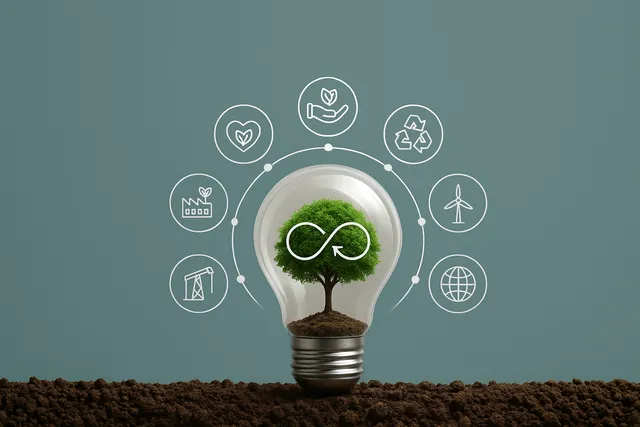
Is the Circular Economy the New Climate?
Climate action may be losing political momentum, but the Circular Economy is moving into focus more than ever. It ranks among the most effective levers for decarbonisation and is simultaneously developing into a billion-dollar market capable of strengthening Europe's competitiveness and security of supply. For companies, this creates a strategic window of opportunity: circular models unlock new value creation, reduce dependencies, and make organisations more resilient. At the same time, it is becoming clear that many businesses lack the concrete data, assessment frameworks, and practical decision-support tools they need — and that is precisely where the greatest transformation potential lies.
Read more
Book a demo
Book a free demo and learn more
Talk to our experts and see NetCero in action.
Book a demo